 MotionLab
Hip Flexor Stretches: The 7 That Actually Work (Iliopsoas, Quad, Groin)
MotionLab Editorial · 8 min read · Mobility
Tight hip flexors cause lower back pain, poor posture, and reduced athletic performance. These 7 evidence-based hip flexor stretches target the iliopsoas, rectus femoris, and TFL — including the one mistake that makes most people's stretching useless. The iliopsoas is the only muscle connecting the lumbar spine directly to the femur — when it shortens, it forces the lower back into increased lordosis, driving the most common desk-worker back pain pattern
Key Takeaways
- ✓The iliopsoas is the only muscle connecting the lumbar spine directly to the femur — when it shortens, it forces the lower back into increased lordosis, driving the most common desk-worker back pain pattern
- ✓Most people perform the kneeling hip flexor stretch incorrectly: the posterior pelvic tilt (tucking the tailbone) is what makes it effective; without it, you are loading the lumbar spine, not lengthening the muscle
- ✓Tight hip flexors actively inhibit the gluteus maximus through reciprocal inhibition — this is why weak glutes and tight hips almost always occur together and why stretching alone is only half the fix
- ✓7 minutes of daily targeted hip flexor work produces measurable improvements in hip extension range of motion within 3–4 weeks of consistent practice
Why Hip Flexors Get Tight
The hip flexors are a group of muscles that connect the pelvis and lower spine to the femur, responsible for lifting the thigh and bringing the torso toward the legs. The primary players are the iliopsoas — itself a combination of the psoas major and iliacus — the rectus femoris (the only quadriceps muscle that crosses the hip joint), and the tensor fasciae latae (TFL), which runs along the outer hip.
The modern epidemic of hip flexor tightness is primarily a sitting problem. When you are seated, the hip joint is held at approximately 90 degrees of flexion. In this position, the hip flexors are not stretched or loaded — they are shortened and unloaded. After two hours in this position, the muscles adapt by reducing their resting length. After eight hours — close to the average daily seated time for office workers — this adaptation is substantial. The psoas major, in particular, has a resting length that decreases within a single prolonged sitting session. Repeat this for weeks and months, and the accumulated shortening becomes a structural feature of how the muscle functions.
For athletes, the pattern is different but the outcome is similar. High-intensity hip flexor usage during sport — sprinting, kicking, climbing — without corresponding flexibility work creates contractile imbalances. Runners frequently develop iliopsoas tightness from the repeated resisted hip flexion of the running stride without systematic eccentric work through the full extension range. The psoas becomes strong at short range and unavailable at long range — the functional definition of tightness.
What Tight Hip Flexors Actually Do to Your Body
The consequences of tight hip flexors extend well beyond the hips themselves, because of the psoas major's unique anatomy. It is the only muscle in the body that directly connects the lumbar spine to the leg — originating from the vertebral bodies and transverse processes of L1 through L5 and attaching at the lesser trochanter of the femur. When it shortens, it simultaneously pulls the lumbar vertebrae into increased anterior tilt, increasing lordosis, and limits hip extension, forcing compensatory movement from the lumbar spine during any activity requiring the leg to move behind the body.
This is the mechanical origin of the most common lower back pain pattern associated with desk work. A shortened psoas creates an anteriorly tilted pelvis, increasing compressive load on the posterior lumbar facet joints and posterior disc margins. The erector spinae and quadratus lumborum must work harder to maintain upright posture against the anterior tilt force. The result is the chronic, diffuse lower back fatigue that desk workers describe: muscles that feel perpetually overworked despite not being used intensively.
The second major consequence is gluteal inhibition. Reciprocal inhibition is a fundamental neurological principle: when a muscle is chronically shortened and tonically active, it reflexively inhibits its antagonist. The hip flexors and gluteus maximus are functional antagonists for hip extension. When the hip flexors are tight, they maintain a mild tonic contraction that chronically suppresses glute activation — not from disuse alone but from active neurological inhibition. The practical consequences include reduced power in jumping, sprinting, and climbing; knee instability under load; and further lumbar compensation as the primary hip extensor is unavailable.
For posture, shortened hip flexors pull the pelvis into anterior tilt, forcing the lumbar spine into excessive extension, the ribcage into a flared position, and the upper back into compensatory kyphosis. The characteristic desk-worker posture — lumbar arch, belly forward, rounded upper back — has the shortened psoas as one of its primary structural drivers.
The 7 Stretches
Perform these daily or on most days. Hold each stretch for the duration specified — shorter holds produce only temporary changes.
1. Half-Kneeling Hip Flexor Stretch
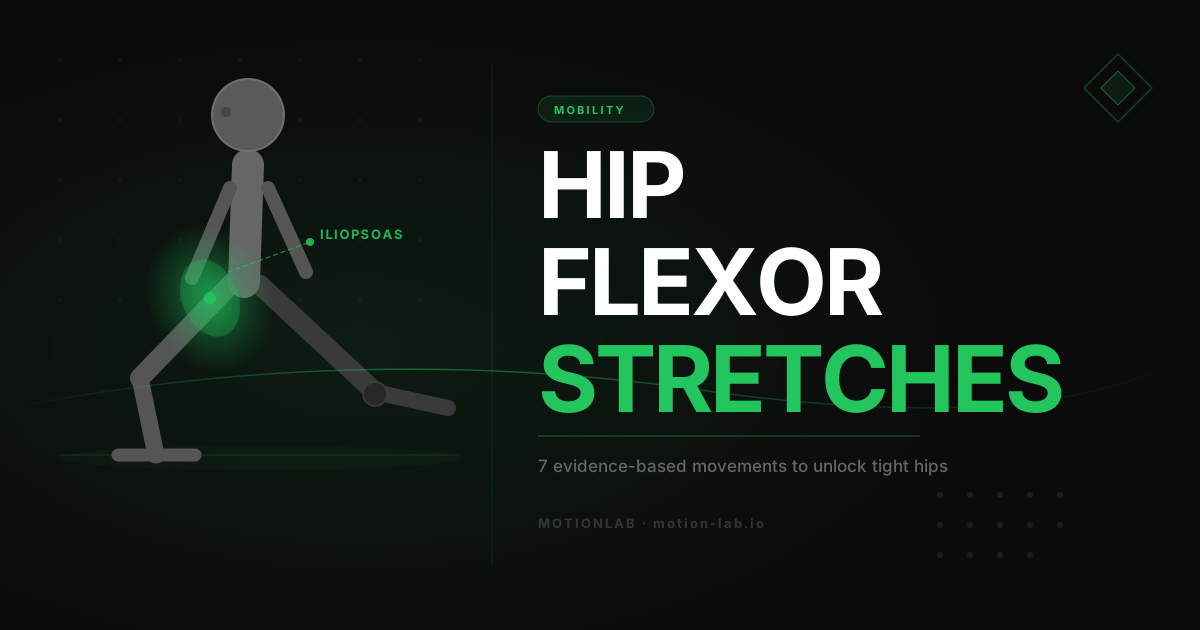
The most effective single intervention for iliopsoas tightness — and the most commonly performed incorrectly. Begin half-kneeling with your right knee down. Before moving forward, perform an active posterior pelvic tilt: tuck your tailbone by squeezing the right glute and lightly engaging your lower abdominals until your lower back flattens. Maintain this tilt throughout. Now shift your hips forward a few centimetres. You should feel a pull at the front of the right hip and upper thigh — this is the iliopsoas under genuine tension. If you feel pressure in your lower back, you have lost the tilt. Hold 60 seconds per side, twice.
2. Wall-Assisted Hip Flexor Stretch
Stand facing away from a wall. Bend your right knee and rest the top of your right foot against the wall behind you. Step your left foot forward into a lunge. The wall keeps your shin vertical, isolating the hip flexor. Apply the same posterior pelvic tilt and feel the stretch at the front of the right hip. Hold 45 seconds each side. The wall provides constant feedback: if your shin moves away from the wall, you are compensating with lumbar extension.
3. Supine Psoas Release
Lie on the edge of a bed or bench. Let your right leg hang off the edge at the knee. Pull your left knee toward your chest and hold it — this creates the posterior pelvic tilt passively. With the tilt held, allow the right leg to hang freely under gravity. Hold 2 to 3 minutes each side. The long passive hold is important: the psoas contains a high proportion of slow-twitch fibres that respond better to extended holds than brief aggressive stretching.
4. Couch Stretch (Rectus Femoris Emphasis)
Kneel in front of a wall. Bring your right knee toward the wall and rest your right shin vertically against it, toes pointing up. Bring your left foot forward into a lunge. Apply posterior pelvic tilt. The stretch should travel from the front of the hip down through the quadriceps — this is the rectus femoris being lengthened simultaneously with the iliopsoas, something the kneeling stretch alone does not achieve. Hold 60 to 90 seconds each side.
5. Lizard Pose
From downward dog, step your right foot outside your right hand, placing it flat on the floor. Sink your hips toward the ground, feeling a deep stretch in the left hip flexor (the trailing leg). For additional depth, lower your left knee to the floor. Hold 60 seconds each side. The lizard pose combines hip flexor lengthening with simultaneous hip external rotation, targeting the TFL and iliacus components not optimally addressed in purely sagittal-plane stretches.
6. Pigeon Pose
From a plank, bring your right knee toward your right wrist and let the right shin rest diagonally on the floor. Extend the left leg straight behind you. Square the hips toward the floor. While the primary stretch is in the right hip's external rotators, the hip flexors of the trailing left leg come under significant tension. Hold 90 seconds each side — the deep hip capsule and external rotators respond to extended positions, not brief holds.
7. Standing TFL Stretch
Stand with feet together. Cross your right foot behind your left. Reach your right arm overhead and lean laterally to the left, simultaneously pushing your right hip out to the right. Feel the pull along the outer right hip from the iliac crest down the lateral thigh. Hold 35 seconds each side. The crossed-leg position is essential — crossing behind rather than in front is what creates TFL tension. TFL tightness contributes to IT band syndrome, lateral knee pain, and the hip shift many runners develop during long efforts.
Why Most People Don't Get Results
The most common reason hip flexor stretching produces minimal improvement is insufficient hold duration. The fascia surrounding the iliopsoas — the iliac fascia and psoas fascia — is particularly dense and responds slowly to mechanical loading. Brief 10 to 20 second holds produce temporary range improvement that reverses within minutes. Research on connective tissue extensibility consistently shows that holds of 60 to 120 seconds are required for durable changes in tissue length, and that daily repetition is necessary to maintain those changes.
The second most common reason is addressing only one component of the hip flexor group. The iliopsoas, rectus femoris, and TFL all contribute to hip flexor tightness but respond to different stretch positions. A routine consisting only of the kneeling lunge adequately targets the iliopsoas but misses the rectus femoris (which requires simultaneous knee flexion and hip extension — the couch stretch) and the TFL (which requires hip extension with abduction or internal rotation bias — the lizard pose and standing TFL stretch).
The third issue is stretching without complementary strengthening. Stretching increases range of motion but does not produce strength through that new range. If you stretch your hip flexors to gain 15 additional degrees of hip extension without simultaneously training the glutes to use that range, the nervous system will restrict access to the extended position under load as a protective response. Glute bridges, single-leg Romanian deadlifts, and hip thrusts are necessary complements — they train the gluteus maximus through the hip extension range your improved hip flexors now allow.
Building the Daily Habit
The minimum effective dose for meaningful hip flexor improvement is approximately 7 minutes per day. A sustainable daily structure: the kneeling hip flexor stretch (60 seconds each side) and the supine psoas release (2 minutes each side) performed in the morning before work. Three times per week, extend this to include the couch stretch and lizard pose in the evening.
The morning placement is intentional. Morning is the period of maximum hip flexor tightness — the accumulation of overnight shortened-position rest and the preceding day's sitting is at its peak. Stretching in the morning resets this tightness before the next day's sitting begins, breaking the cycle rather than managing it reactively at the end of the day.
Typical timelines: noticeable improvement in hip extension range of motion at 2 to 3 weeks of daily practice. Functional carry-over — less lower back stiffness, improved posture, better glute activation during exercise — at 4 to 6 weeks. Resolution of chronic hip flexor tightness, where it no longer returns after a week without stretching, at 8 to 12 weeks of consistent practice.
A useful objective progress check: the Thomas test. Lie on a table and draw both knees to your chest, then lower one leg at a time. If the lowered leg's thigh stays above horizontal (does not reach the table surface), the hip flexors on that side remain short. When both legs reach the table in neutral alignment, you have restored functional resting length. Use this as your periodic benchmark rather than relying on how the stretch feels — subjective perception adapts faster than the tissue actually changes.
Related reading
- Why Hip Flexor Tightness Is Wrecking Your Performance (And How to Fix It)
- The Complete Guide to Hip Flexor Stretches: Why Tight Hips Are Ruining Your Movement
- Hip Internal Rotation Stretches: The Most Restricted Hip Movement and How to Restore It
- Hamstring Stretches: The 8 Best for Tight Hamstrings (And the Neural Tension Test That Changes Everything)
- Hip Mobility Exercises: The 12 Best Movements for Unlocking Tight Hips
- Complete Hip Mobility Guide
Put it into practice
Ready to apply what you've learned?
MotionLab builds personalised mobility sessions around your specific restrictions — so every minute you invest targets what you actually need.
Start a session on MotionLab →