 MotionLab
Shoulder Stretches You Can Do at Your Desk
MotionLab Editorial · 10 min read · Mobility
Six gentle shoulder stretches you can do at your desk in about three minutes: hold times, form cues, how often to stretch, and when to stop and get checked. Six seated or standing moves cover the shoulders in about three minutes: shrug and roll, chest opener, cross-body stretch, overhead triceps stretch, shoulder blade squeeze, and a seated upper-body twist Hold the main stretches about 15–30 seconds, breathe freely, don’t bounce, and stop at gentle tension rather than pain (Mayo Clinic)

Key Takeaways
- ✓Six seated or standing moves cover the shoulders in about three minutes: shrug and roll, chest opener, cross-body stretch, overhead triceps stretch, shoulder blade squeeze, and a seated upper-body twist
- ✓Hold the main stretches about 15–30 seconds, breathe freely, don’t bounce, and stop at gentle tension rather than pain (Mayo Clinic)
- ✓Office workers with neck and shoulder pain who stretched twice a day, five days a week for four weeks improved more than an ergonomics-advice-only group
- ✓Stretching helps, but so does the setup: shoulders relaxed, elbows close to the body, and getting up often. Deformity, inability to move the arm, or pain with chest symptoms needs urgent care
Shoulder Stretches You Can Do at Your Desk
The best shoulder stretches you can do at your desk are slow, seated or standing moves that open the chest, free the back of the shoulder, and reset raised traps: a shrug and roll, a chest opener, a cross-body stretch, an overhead triceps stretch, a shoulder blade squeeze, and a seated upper-body twist. Hold the main stretches about 15–30 seconds, breathe normally, and stop at gentle tension, never pain. That mirrors the workplace upper-body stretches from Mayo Clinic, the seated chest and twist moves in the NHS sitting exercises, and the desk shrugs and “executive stretch” from the NIH Division of Occupational Health and Safety.
Shoulder stretches you can do at your desk need three rules: no floor, almost no equipment, and nothing that looks strange on a video call. Every move below works in an ordinary office chair or beside it, and the whole sequence takes about three minutes.
This guide covers why a desk day tightens your shoulders, the six stretches step by step, how long to hold them, how often to do them, when to stop and get checked, and the setup changes that make the stretches last. For a fuller shoulder system that includes thoracic and pec work off the chair, see shoulder stretches.
Why Do Your Shoulders Get Tight at a Desk?
A long desk day asks your shoulders to hold your arms out toward a keyboard and mouse while your upper back rounds toward a screen. Mayo Clinic notes that sitting at a desk for a long time can put a lot of stress on the neck, shoulders, and upper back, and that stress can make you stiff and sore.
Three desk habits do most of the damage:
- Raised shoulders. Deadlines and tense typing often pull the traps up toward the ears and leave them there.
- Rounded chest. Reaching forward for a keyboard or mouse shortens the chest and leaves the muscles between the shoulder blades long and weak.
- Arms held away from the body. OSHA’s computer workstation guidance warns that a keyboard or mouse that’s too high, too low, or too far away can lead to awkward wrist, arm, and shoulder postures, and that elbows should stay close to the body with the shoulders relaxed.

Stress plays a part too. When you’re tense, the shoulders rise first. The stretches below take the shoulders back through the ranges a desk day takes away.
What Are the Best Shoulder Stretches to Do at Your Desk?
Before you start, sit tall with your feet flat on the floor and let your shoulders drop. Move slowly. Don’t bounce. Expect tension, not pain.
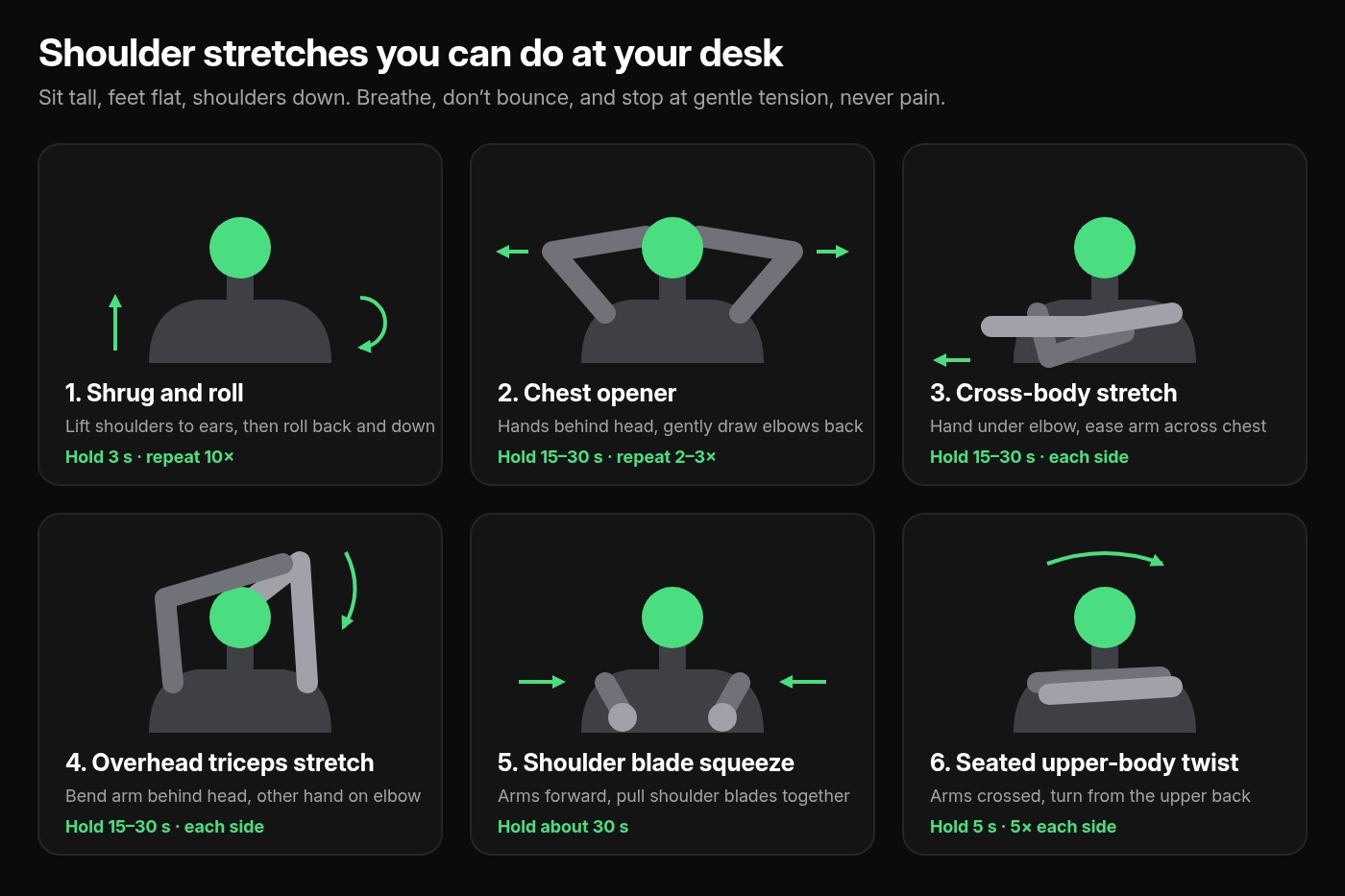
1. Shrug and roll
Slowly lift your shoulders up toward your ears, hold for about 3 seconds, then roll them back and down. Repeat about 10 times (NIH; NIH MedlinePlus Magazine). This is the quickest way to drop traps that have crept up during a tense call.
2. Chest opener
Sit upright, lace your fingers behind your head, and gently draw your elbows back as you inhale. Hold for about 15–30 seconds, then relax (Mayo Clinic; NIH executive stretch holds about 20 seconds). Or, as the NHS sitting exercises suggest, extend your arms out to the side, gently push your chest forward and up, and hold 5–10 seconds, five times.
3. Cross-body stretch
Place one hand under the opposite elbow. Lift that elbow and stretch it across your chest without rotating your torso. Hold for 15–30 seconds, then switch sides (Mayo Clinic). You’ll feel this in the back of the shoulder.
4. Overhead triceps stretch
Lift one arm and bend it behind your head. Place your other hand on the bent elbow to help stretch the upper arm and shoulder. Hold for 15–30 seconds and switch sides (Mayo Clinic).
5. Shoulder blade squeeze
Stand or sit with your arms extended forward, parallel to the floor. Pull your shoulder blades together behind you, letting the arms spread a little wider, and hold about 30 seconds (Mayo Clinic). This is the active counterpart to the chest opener.
6. Seated upper-body twist
Sit upright with your feet flat. Cross your arms and reach for your shoulders. Without moving your hips, turn your upper body to one side as far as is comfortable, hold for 5 seconds, and switch sides. Do about five times each side (NHS sitting exercises).

Want a quick version?
If you only have 30 seconds between calls, do five shrug-and-rolls and one chest opener. Save the full sequence for a natural break, like after a meeting or before lunch.
How Long Should You Hold Each Shoulder Stretch?
Mayo Clinic uses about 15–30 seconds for its workplace upper-body stretches, and its upper-back squeeze holds about 30 seconds. The NIH executive stretch holds about 20 seconds; shrugs use a short 3-second hold repeated about 10 times. The NHS sitting exercises use shorter 5–10 second holds with more reps for the chest stretch and twist.
Whichever you choose, keep Mayo Clinic’s three rules in mind:
- Breathe freely through each hold
- Don’t bounce at the end of the range
- Expect tension, not pain. If you feel pain, you’ve gone too far. Ease off to where it feels comfortable and hold there
The full routine at 15–30 seconds per position, both sides where needed, lands at roughly three minutes.
How Often Should You Do Shoulder Stretches at Your Desk?
Little and often beats one long session. In a randomized controlled trial of 96 office workers with chronic neck pain (often felt into the shoulders), everyone got a brochure on posture and workstation ergonomics. One group also did neck and around-shoulder stretches twice a day, five days a week, for four weeks. After four weeks, the stretching group had greater improvements in pain, neck function, and physical quality of life than the advice-only group. People who stretched at least three times a week did better than those who stretched less.
A realistic plan built on that:
- Twice a day: the full six-move routine, for example mid-morning and mid-afternoon
- Every time you get up: a few shrug-and-rolls and a shoulder blade squeeze
- Every day: get up and move. Mayo Clinic recommends breaking up the workday with stretches and other activity so the neck, shoulders, and upper back don’t stay loaded in one position

If you’d like that longer daily session planned for you, MotionLab builds guided mobility sessions of 7, 15, or 25 minutes around your restrictions, using AI powered by Gemini. MotionLab is live on the web and Android. Start at /signup when you’re ready.
When Should You Stop or See a Professional?
These stretches are meant for everyday desk stiffness. They aren’t a treatment for an injury or a diagnosed condition, and this article isn’t medical advice.
Stop the stretch if it causes sharp pain, if pain spreads down the arm, or if you feel numb, tingly, or weak. The NHS advises staying gently active with the shoulder, but not making up strenuous exercises or pushing through things that seem to make it worse.
Get emergency care if shoulder pain comes with trouble breathing, chest tightness, or sweating, or if after a fall the shoulder looks deformed, you can’t move the arm, or you have intense pain and sudden swelling (Mayo Clinic).
Contact a doctor or physiotherapist if your shoulder pain:
- Doesn’t improve after about two weeks, or is getting worse (NHS; Mayo Clinic)
- Makes it very difficult to move your arm or shoulder
- Comes with swelling, redness, or warmth around the joint
- Started after an injury or accident
If you’re unsure whether stretching is right for you, especially after shoulder surgery or with a known shoulder condition, ask a healthcare professional first.
What Desk Setup Changes Help Your Shoulders?
Stretching undoes some of a desk day. Changing the desk stops it from building up again. OSHA suggests:
- Shoulders relaxed, elbows close to the body. Put the keyboard directly in front of you so you aren’t reaching.
- Elbows about keyboard height. A surface that’s too high raises the shoulders; one that’s too low bends the wrists. Adjust the chair or tray so the forearms sit roughly parallel to the floor.
- Mouse within easy reach. A pointer that’s too far away pulls the elbow away from the body and keeps the shoulder elevated.
Pair that with screen and chair setup: monitor at eye level with how high should your monitor be, and a supported sit from how to sit at a desk without back pain. Add a few neck stretches you can do at your desk and your whole upper body gets a break, not just the shoulders.
What Mistakes Make Desk Shoulder Stretches Less Effective?
- Pushing into pain. A stronger pull isn’t a better stretch. Mild tension is the target.
- Rotating the torso on the cross-body stretch. Keep the body facing forward so the stretch stays in the back of the shoulder.
- Shrugging during the chest opener. If the traps rise, the stretch disappears. Drop the shoulders first, then open the elbows.
- Yank the elbow on the overhead stretch. Light pressure at most. Let the weight of the arm do most of the work.
- Holding your breath. Breathe normally. Tension in your breathing usually shows up as tension in your neck and shoulders.
- Stretching once and calling it fixed. The research benefit came from doing it twice a day for weeks, not a single session.
- Ignoring the setup. Stretching on a keyboard that’s still too high or too far away only buys temporary relief.
Shoulder Stretches at Your Desk FAQ
What is the best shoulder stretch to do at your desk?
There isn’t one best stretch, because the shoulder and upper back tighten in several places. If you only do one, a gentle chest opener (hands behind the head, elbows drawn back) is quick and discreet. The full six-move routine covers shrugs, the chest, the back of the shoulder, the triceps, the mid-back, and a twist.
How long should you hold a shoulder stretch?
About 15–30 seconds is the range Mayo Clinic uses for workplace upper-body stretches. The upper-back squeeze holds about 30 seconds. Shorter 5–10 second holds with more reps, as in the NHS sitting exercises, also work. Breathe, don’t bounce, and stop at tension, not pain.
How often should I stretch my shoulders at work?
A full routine twice a day plus a few shrugs whenever you get up is a practical target. In a trial of office workers with neck pain, stretching twice a day, five days a week for four weeks reduced pain more than ergonomics advice alone.
Can I do shoulder stretches sitting in my office chair?
Yes. The shrug and roll, chest opener, cross-body stretch, overhead triceps stretch, shoulder blade squeeze, and seated upper-body twist all work seated. Sit tall with your feet flat and shoulders relaxed.
Should shoulder stretches hurt?
No. Mayo Clinic’s rule is to expect tension but not pain. If you feel pain, you’ve gone too far. Back off to a comfortable range and hold there.
When should I see a doctor about shoulder pain?
Get emergency care for shoulder pain with chest symptoms, or after a fall if the shoulder looks deformed, you can’t move the arm, or pain and swelling are intense (Mayo Clinic). See a doctor or physiotherapist if the pain doesn’t improve after about two weeks, is getting worse, or makes it hard to move the arm (NHS, Mayo Clinic).
Do desk shoulder stretches fix bad posture?
They help, but they work best with a better setup. Keep the shoulders relaxed, elbows close to the body, keyboard and mouse within easy reach, and get up regularly. Stretching handles the stiffness. The setup reduces what causes it.
Sources
Related reading
- Top 10 Stretches to Undo Tech Neck and Desk Posture
- The 8 Most Effective Shoulder Stretches for Tight, Painful Shoulders
- Thoracic Spine Mobility for Desk Workers and Athletes
- Shoulder Mobility Exercises: The 10 Best Movements for Tight, Stiff Shoulders
- Why Are My Hamstrings Always Tight? The Real Causes and How to Fix Them
- Shoulder & Thoracic Spine Guide
Put it into practice
Ready to apply what you've learned?
MotionLab builds personalised mobility sessions around your specific restrictions — so every minute you invest targets what you actually need.
Start a session on MotionLab →