 MotionLab
Wrist Stretches You Can Do at Your Desk
MotionLab Editorial · 12 min read · Mobility
Six wrist stretches you can do at your desk, with hold times from NHS and physio guidance, how often to do them, and when wrist pain or tingling needs a doctor. Typing and using a mouse keep your wrists and fingers working in a small range for hours, so the forearms and wrists can feel stiff or achy by the end of the day.

Key Takeaways
- ✓Typing and using a mouse keep your wrists and fingers working in a small range for hours, so the forearms and wrists can feel stiff or achy by the end of the day. Short stretch breaks at your desk are the easiest counter
- ✓Six moves cover it: wrist bends, a wrist flexor stretch, a wrist extensor stretch, the prayer stretch, forearm turns, and tendon glides. The whole routine takes about 4 minutes and needs no equipment
- ✓Hold times come from health guidance: 15 to 30 seconds for the flexor and extensor stretches (Chartered Society of Physiotherapy), about 30 seconds for other stretches (Mayo Clinic and NHS hand therapy leaflets), and slow repetitions for the moving exercises
- ✓Stop any move that hurts or brings on tingling. See a doctor if wrist pain hasn’t improved after 2 weeks, stops you doing normal activities, or comes with numbness, tingling, swelling, or a fever
Wrist Stretches at Your Desk
The best wrist stretches at your desk are simple moves you can do from your chair: bending your wrist forward and back with your elbow on the desk, easing your fingers back to stretch the inside of your forearm, easing your hand down to stretch the outside, pressing your palms together in a prayer stretch, turning your forearm palm up and palm down, and running your fingers through a set of tendon glides. Move slowly, stop at gentle tension, and repeat the routine a few times a workday.
The Mayo Clinic suggests stretching until you feel a slight pull, holding for about 30 seconds, and stopping if you feel pain. This guide gives you six wrist stretches you can do at work, how long to hold each one, how often to do them, what the research says, and when wrist pain needs more than a stretch. If you want a longer routine with strengthening work, our full guide to wrist stretches goes further.
Why Do Your Wrists Feel Stiff After a Day at the Computer?
Your wrist can bend forward and back, tilt side to side, and turn with your forearm. Your fingers can open fully and curl into a tight fist. A day of typing asks for almost none of that range. Your hands hover over the keys or the mouse in roughly the same position for hours, making thousands of small, repeated movements.
A few things tend to add up:
- The same small movements, over and over. Typing and clicking work the muscles of the forearm, which control the wrist and fingers, in a narrow range all day.
- Bent wrists. A keyboard that’s too high or too low, a laptop on your lap, or resting the heel of your hand on a hard edge can keep your wrists bent back or tilted for long stretches. Here’s how to position your wrists when typing.
- Gripping the mouse. Holding a mouse tightly keeps the fingers and forearm working even when you’re only reading.
- Not taking breaks. Even a well-set-up desk gets uncomfortable if you don’t change position for hours.

Stretching won’t undo a day of typing on its own, but it’s the quickest way to move stiff wrists and fingers without leaving your desk. Wrist discomfort often travels with tension higher up, so it pairs well with neck stretches and shoulder stretches you can do at your desk.
6 Wrist Stretches You Can Do at Your Desk
Sit tall with your feet flat and your shoulders relaxed. Take off a watch or tight bracelet if it gets in the way. Breathe freely, don’t bounce, and move only to a gentle stretch. If a move hurts or brings on tingling or numbness in your fingers, stop.
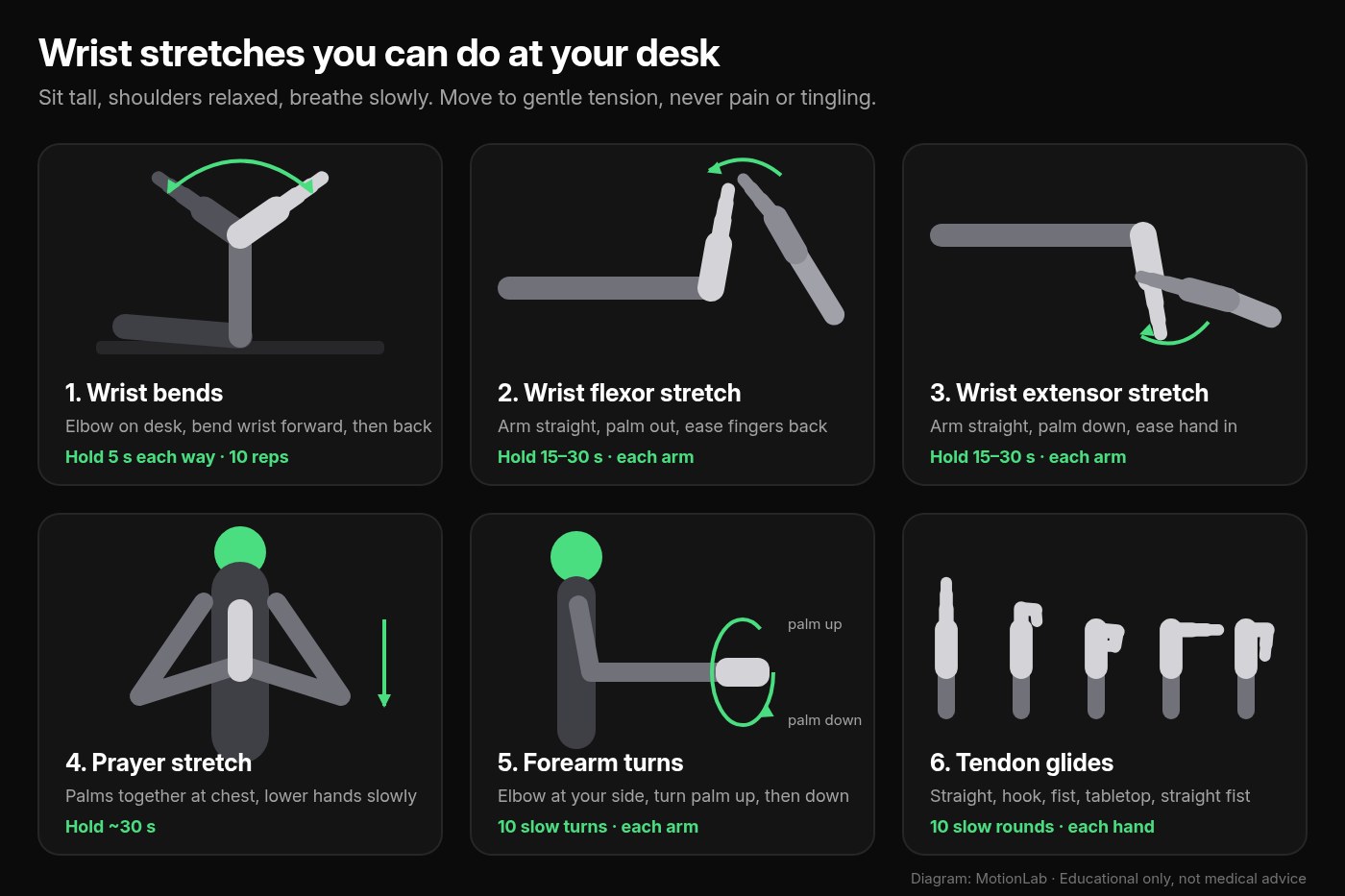
1. Wrist bends
Rest your elbow on the desk with your forearm pointing up and your wrist straight. Gently bend your wrist forward and hold for 5 seconds, straighten it, then bend it back and hold for 5 seconds. The Chartered Society of Physiotherapy describes this move and suggests 3 sets of 10; at your desk, one set of 10 makes a good warm-up.
2. Wrist flexor stretch
Hold one arm straight out in front of you, palm facing away and fingers pointing up, as if signalling stop. With your other hand, gently ease your fingers back toward you until you feel a stretch along the inside of your forearm. The Chartered Society of Physiotherapy suggests holding 15 to 30 seconds. Switch arms.
3. Wrist extensor stretch
Hold one arm straight out with your palm facing down, and let your hand bend down at the wrist. With your other hand, gently press the back of your hand toward you until you feel a stretch along the top of your forearm. Hold 15 to 30 seconds, as the Chartered Society of Physiotherapy suggests, then switch arms.
4. Prayer stretch
Press your palms together in front of your chest, fingers pointing up and elbows out. Keeping your palms together, slowly lower your hands toward your waist until you feel a stretch in your wrists and the inside of your forearms. This palm-to-palm stretch appears in a St George’s NHS hand therapy leaflet; following the Mayo Clinic general guidance, hold for about 30 seconds.
5. Forearm turns
Tuck your elbow in at your side and bend it to a right angle, with your thumb pointing up. Slowly turn your palm to face the ceiling as far as is comfortable, then turn it to face the floor. The St George’s NHS leaflet uses these turns to keep the forearm moving. A Dorset County Hospital NHS leaflet suggests about 10 repetitions for moving wrist exercises. Do 10 slow turns with each arm.
6. Tendon glides
Hold one hand up with your fingers straight and your wrist in line with your forearm. Move slowly through each position, going back to straight fingers between each one: a hook fist (bend only the middle and end finger joints), a full fist, a tabletop (bend only at the big knuckles, fingers straight), and a straight fist (fingertips into the base of your palm, knuckles flat). A Berkshire Healthcare NHS physiotherapy page describes this tendon gliding sequence with 10 to 20 repetitions; 10 slow rounds per hand is plenty at your desk.
If you are short on time, do the wrist flexor and extensor stretches. Together they cover the inside and outside of the forearm in about two minutes. For the rest of your upper body, see upper back stretches you can do at your desk and our desk stretches routine.
How Often Should You Stretch Your Wrists at Work?
There’s no single official dose for desk stretching, but health guidance and research give a useful range:
- A few short sessions a day. NHS hand therapy guidance for stiff wrists, like the Dorset County Hospital leaflet, suggests doing wrist stretches 3 to 4 times a day and holding each one for 30 seconds. That leaflet is written for people with wrist stiffness, so treat it as an upper limit for a healthy desk worker rather than a prescription.
- Breaks matter as much as the stretches. In a 2007 NIOSH field study of 51 data-entry workers, adding four extra 5-minute breaks to the workday lowered discomfort and eyestrain, and work output held up despite the lost time. Workers asked to stretch during breaks only did so in 25 to 39% of them, and the study couldn’t show an extra effect from stretching. The lesson: the routine only helps if it’s short enough that you actually do it.
- Workplace stretching helped office workers. A 2018 randomized trial of 142 office workers with neck, shoulder, and lower back pain found that a workplace stretching program reduced pain scores compared with a control group. It didn’t focus on the wrists, but it shows desk stretching is worth the few minutes.
- Exercise is not a proven fix for carpal tunnel syndrome. A Cochrane review of 16 trials with 741 people found only limited, very low quality evidence that exercises and mobilisation help carpal tunnel syndrome. The NHS says there’s a small amount of evidence that hand exercises ease the symptoms. Stretches can make stiff wrists feel better, but they aren’t a treatment for numbness or tingling.
A practical plan: do the six moves once mid-morning and once mid-afternoon, and do a quick flexor and extensor stretch whenever you finish a long typing session.
Stretches pair well with getting up, too. Walking lets your arms swing and your hands rest in a way no keyboard break can; here’s how often to take a walking break from sitting.
If you’d rather follow a routine than remember one, MotionLab builds guided mobility sessions of 7, 15, or 25 minutes around your stiff spots, like the wrists, neck, and shoulders, using AI powered by Gemini. MotionLab is live on the web and Android. Start at /signup when you’re ready.
Desk Setup Changes That Help Sore Wrists
Stretching treats the stiffness. Your setup and habits decide how fast it comes back.
- Keep your keyboard and mouse close and at elbow height. The Berkshire Healthcare NHS physiotherapy advice suggests keeping them close, at elbow height, resting your forearms lightly, and keeping your wrists straight. How to position your wrists when typing goes through it step by step.
- Set your chair first. Your chair height decides where your elbows sit relative to the desk. How to adjust your office chair walks through height, depth, and armrests.
- Don’t type on a laptop all day. A laptop puts the screen and keyboard too close together for both to be right. An external keyboard and mouse help; see our laptop desk setup guide.
- Loosen your grip. Hold the mouse lightly, let go of it when you’re reading, and type with a light touch instead of hammering the keys.
- Change tasks. The NHS suggests cutting down on things that make you bend your wrist often or grip hard. Breaking up long typing sessions with calls, reading, or a short walk gives your wrists a rest.
For the full picture, see how to sit at a desk without back pain.
Common Mistakes With Wrist Stretches at Your Desk
- Pulling too hard. A stretch should feel like a slight pull. The Mayo Clinic says that if you feel pain, you’ve stretched too far. Your wrist and finger joints are small, so it takes very little force.
- Stretching into tingling. If a stretch brings on pins and needles or numbness in your fingers, ease off. Those are nerve symptoms, not muscle tightness.
- Bouncing or flicking. Hold steady or move slowly. Shaking your hands out feels good, but it isn’t a stretch.
- Shrugging your shoulders. Keep your shoulders down and relaxed, especially in the prayer stretch and the straight-arm stretches.
- Locking your elbow hard. Keep your arm straight but not jammed. A slight softness at the elbow is fine.
- Stretching once and calling it done. A stretch break helps most when it’s a regular habit, not a one-off at the end of a sore day.
When Should You See a Doctor About Wrist Pain?
This article is general information, not medical advice. Wrist stiffness from typing usually eases with movement and breaks, but wrist pain has many possible causes, from sprains and tendonitis to carpal tunnel syndrome and arthritis, and the NHS advises not trying to diagnose the cause yourself. Stop any exercise that makes your pain worse.

According to the NHS, see a GP or doctor if:
- Wrist pain is stopping you doing normal activities
- The pain is getting worse or keeps coming back
- It hasn’t improved after treating it at home for 2 weeks
- You have tingling or loss of feeling in your hand or wrist
- You have diabetes, because hand problems can be more serious
- Your wrist is painful, warm, swollen, and stiff, or you have wrist pain with a high temperature
Tingling, numbness, or pins and needles in your fingers that’s worse at night, or a weak thumb and trouble gripping, can be signs of carpal tunnel syndrome, which needs proper assessment rather than more stretching.
Get urgent medical help the same day if you have severe wrist pain, you heard a snap or popping noise when you hurt it, you can’t move your wrist or hold things, your wrist has changed shape or colour, or you’ve lost feeling in part or all of your hand. These can be signs of a broken wrist or an infection.
Wrist Stretches at Your Desk FAQ
What are the best wrist stretches to do at a desk?
Good options are wrist bends with your elbow on the desk, a wrist flexor stretch, a wrist extensor stretch, the prayer stretch, forearm turns, and tendon glides. Together they move the wrist forward, back, and through rotation, and take the fingers through their full range, which typing doesn’t do.
How long should I hold a wrist stretch?
The Chartered Society of Physiotherapy suggests holding the wrist flexor and extensor stretches for 15 to 30 seconds, and the Mayo Clinic suggests about 30 seconds for stretches in general. Moving exercises like wrist bends, forearm turns, and tendon glides are done as slow repetitions, about 10 at a time.
How often should I stretch my wrists at work?
Aim for the full routine once or twice a workday, plus a quick flexor and extensor stretch after long typing sessions. Regular short breaks matter too: in a study of data-entry workers, extra 5-minute breaks lowered discomfort without hurting output.
Can wrist stretches help carpal tunnel syndrome?
The evidence is weak. A Cochrane review found only limited, very low quality evidence that exercise and mobilisation help carpal tunnel syndrome, and the NHS says there’s a small amount of evidence that hand exercises ease symptoms. If you have numbness or tingling in your fingers, see a doctor or physiotherapist.
Is it normal for wrist stretches to make my fingers tingle?
No. A wrist stretch should feel like a gentle pull in the forearm. If a stretch brings on tingling or numbness in your fingers, ease off or stop, and see a doctor if it keeps happening or you notice tingling during the day or at night.
When is wrist pain a reason to see a doctor instead of stretching?
See a doctor if wrist pain hasn’t improved after 2 weeks, stops you doing normal activities, comes with tingling or numbness, or your wrist is hot, swollen, and stiff. Get urgent help for severe pain, a snap at the time of injury, or if you can’t move your wrist or hold things.
Sources
Related reading
- Ankle Mobility: The Foundation of Every Movement
- Wrist Stretches: The 8 Best for Tight, Painful Wrists (And Why the Problem Is Usually Further Up the Chain)
- How to Fix Anterior Pelvic Tilt: 7 Stretches, the Strength Work That Makes Them Stick, and Why Posture Alone Isn't Enough
- Why You Can't Touch Your Toes (And the Honest Reason Most Stretching Advice Won't Get You There)
- Calf Stretches: The 7 Best for Tight Calves (And Why Most People Are Only Doing Half the Work)
- Shoulder & Thoracic Spine Guide
Put it into practice
Ready to apply what you've learned?
MotionLab builds personalised mobility sessions around your specific restrictions — so every minute you invest targets what you actually need.
Start a session on MotionLab →