 MotionLab
Hip Stretches You Can Do at Your Desk
MotionLab Editorial · 12 min read · Mobility
Six hip stretches you can do at your desk, with hold times from Mayo Clinic and NHS guidance, how often to do them, and when your hip pain needs a doctor. Sitting keeps your hips bent for hours, so the front of the hip, the glutes, and the inner and outer thigh can feel tight when you finally stand up.

Key Takeaways
- ✓Sitting keeps your hips bent for hours, so the front of the hip, the glutes, and the inner and outer thigh can feel tight when you finally stand up. Short stretch breaks at your desk are the easiest counter
- ✓Six moves cover it: seated hip marching, seated figure-4, seated knee to opposite shoulder, seated inner thigh stretch, standing hip flexor stretch, and standing outer hip stretch. The whole routine takes about 5 minutes
- ✓Hold times come from health guidance: about 30 seconds per stretch (Mayo Clinic), 20 to 30 seconds for the standing hip flexor stretch (NHS), and 5 slow lifts per leg for hip marching (NHS)
- ✓Stop any move that hurts. See a doctor if hip pain hasn’t improved after 2 weeks, stops you sleeping or doing normal activities, or comes with a hot, swollen joint or a fever
Hip Stretches at Your Desk
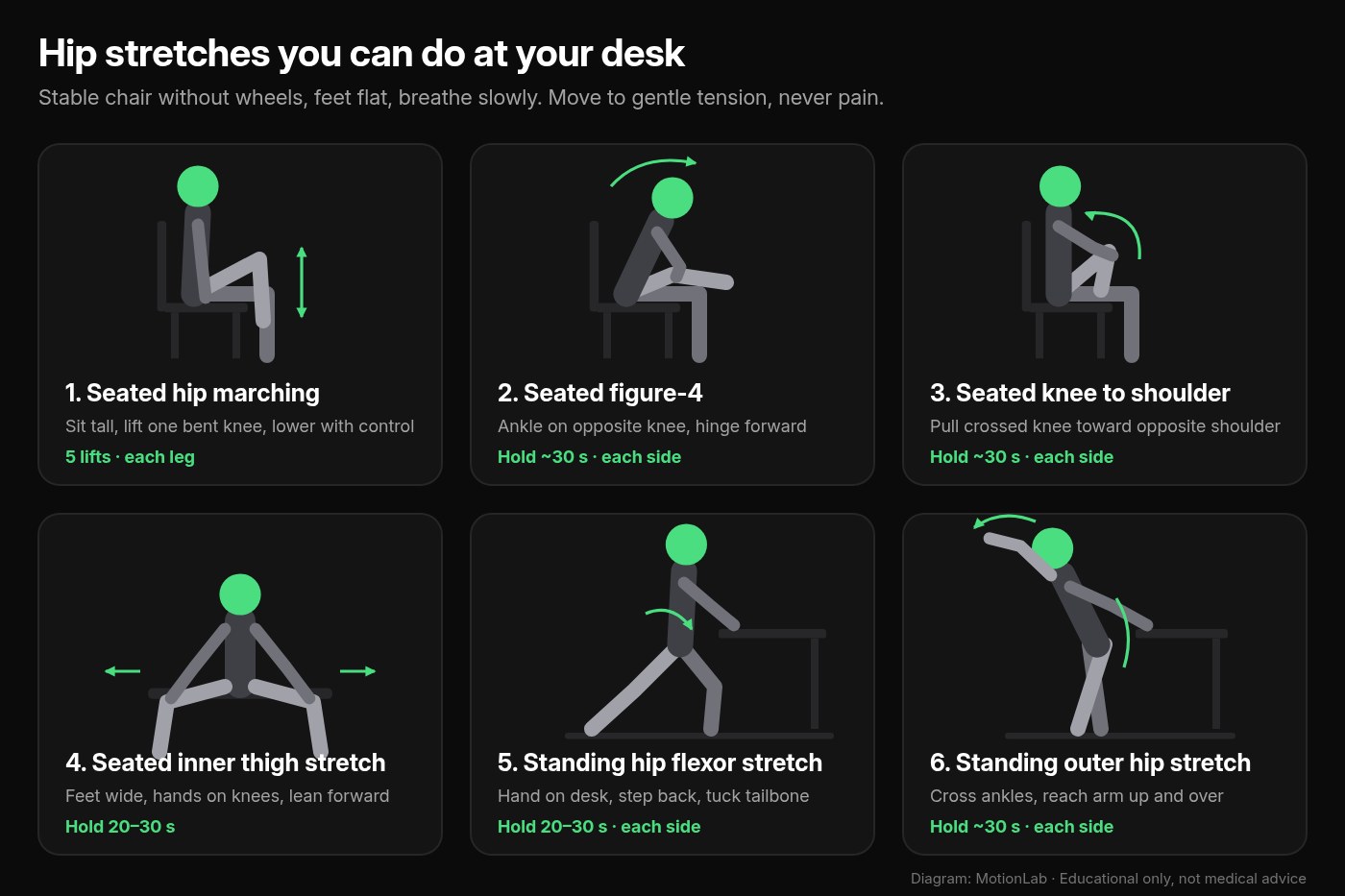
The best hip stretches at your desk are simple moves you can do from a stable chair or with one hand on the desk: lifting each knee in a slow march, crossing an ankle over your knee and hinging forward, pulling a crossed knee toward the opposite shoulder, sitting with your feet wide and leaning forward, stepping one leg back to open the front of the hip, and crossing your ankles to stretch the outer hip. Move slowly, stop at gentle tension, and repeat the routine a few times a workday.
The Mayo Clinic suggests stretching until you feel a slight pull, holding for about 30 seconds, and stopping if you feel pain. This guide gives you six hip stretches you can do at work without lying on the floor, how long to hold each one, how often to do them, what the research says, and when hip pain needs more than a stretch. If you have floor space and want a longer routine, our hip flexor stretches and hip mobility exercises go further.
Why Do Your Hips Feel Tight When You Sit All Day?
Your hips are built to move in every direction: forward and back, out to the side, and in rotation. A desk day asks them to do almost none of that. You sit with your hips bent at roughly a right angle for hours, and the muscles around them stay in one position the whole time.
A few things tend to add up:
- The front of the hip stays shortened. The hip flexors, which lift your knee and bend you at the waist, sit in a shortened position while you’re seated. Many people notice they feel tight for the first few steps after standing up. Why your hip flexors get tight explains what’s going on.
- The glutes switch off. Your buttock muscles do very little while you sit, and a stiff outer hip or glute often shows up as a dull ache in the side of the hip or the lower back. These glute stretches go deeper.
- Crossed legs and one-sided habits. Always crossing the same leg, or leaning onto one hip, keeps the same side in the same position day after day.
- Not moving. Even a good chair gets uncomfortable if you stay put for hours. Changing position matters as much as the position itself.
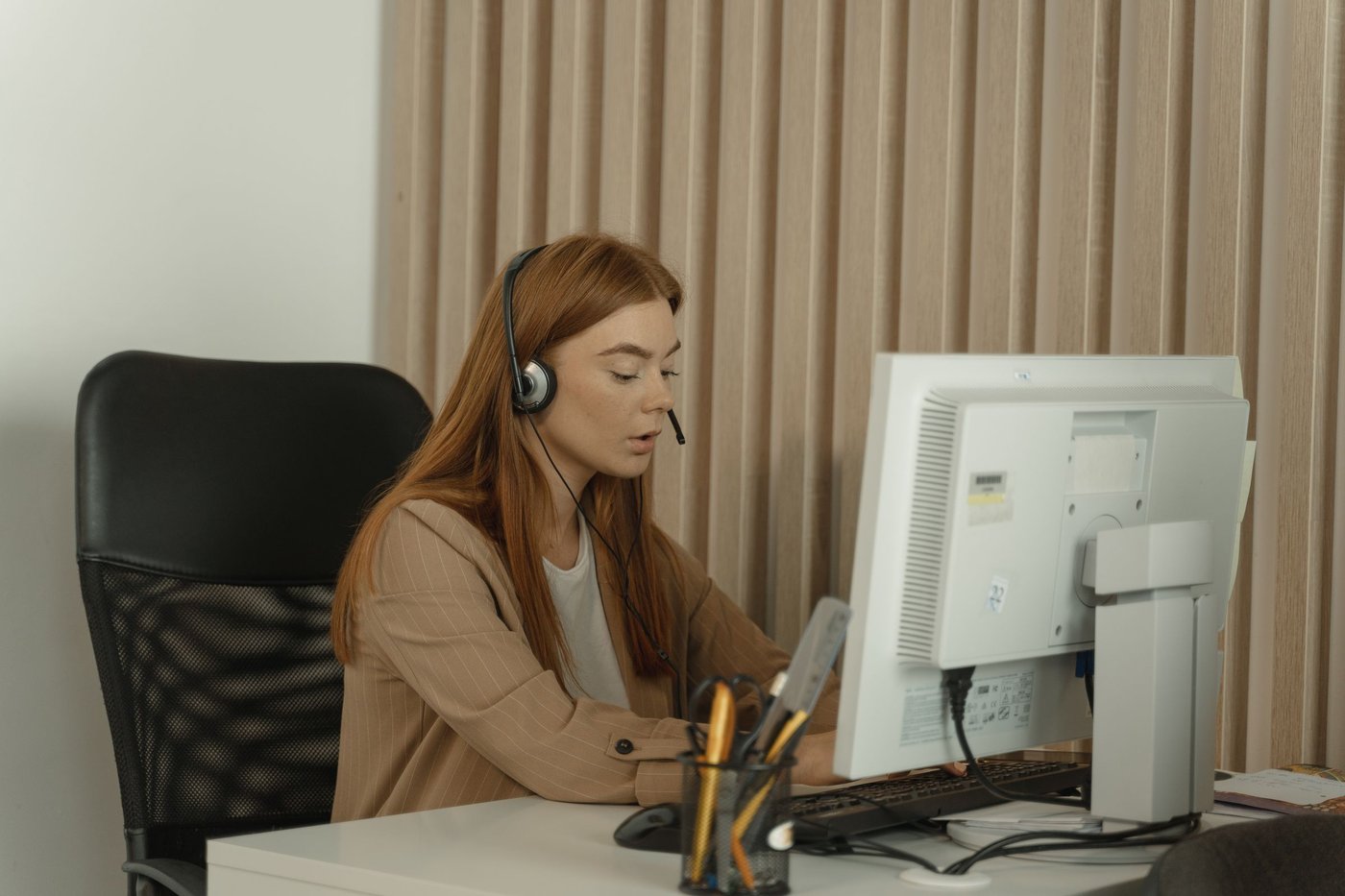
Stretching won’t undo a day of sitting on its own, but it’s the quickest way to move stiff hips without leaving your desk.
6 Hip Stretches You Can Do at Your Desk
Use a solid chair without wheels and without arms, as the NHS recommends for seated exercises, or lock your casters. Sit with your feet flat on the floor and your knees at about a right angle. For the two standing moves, rest a hand on a desk that won’t move. Breathe freely, don’t bounce, and move only to a gentle stretch. If it hurts, you’ve gone too far.
1. Seated hip marching
Sit upright without leaning on the backrest and hold the sides of the chair. Lift one leg, knee bent, as high as is comfortable, then place your foot down with control and switch legs. The NHS sitting exercises suggest 5 lifts with each leg, and say it strengthens the hips and thighs and improves flexibility. It’s a good warm-up for the rest of the routine.
2. Seated figure-4
Rest your right ankle on your left thigh, just above the knee. Place your forearm on the raised knee and, with your back straight, lean forward from your hips until you feel a gentle stretch in your right hip and buttock. The Mayo Clinic includes this seated hip stretch in its stretch routines and suggests holding about 30 seconds, then switching sides.
3. Seated knee to opposite shoulder
From the same crossed-leg position, grasp your right knee with your left hand and, keeping your spine straight, gently pull the knee up toward your left shoulder until you feel a stretch in your right buttock. This is another of the Mayo Clinic seated hip stretches; hold about 30 seconds, then switch sides.
4. Seated inner thigh stretch
Sit toward the front of the chair with your feet flat and wider than your hips, toes turned slightly out. Rest your hands on your inner knees, keep your back straight, and lean forward from your hips while gently easing your knees apart until you feel a stretch along your inner thighs. Following the Mayo Clinic general guidance, hold for 20 to 30 seconds and keep it gentle.
5. Standing hip flexor stretch
Stand facing your desk with one hand on it. Step your right leg back and bend your front knee slightly, keeping both feet pointing forward. Keep your back straight, tuck your tailbone under, and push your right hip gently forward until you feel a stretch in the front of the hip. An NHS physiotherapy leaflet on hip stretches suggests holding 20 to 30 seconds, without arching your back. Switch legs.
6. Standing outer hip stretch
Stand side-on to your desk with your right hand on it. Cross your left leg behind your right at the ankle, then reach your left arm overhead toward your right side until you feel a stretch along the outside of your left hip. The Mayo Clinic describes this iliotibial band stretch with a wall or sturdy support, held for about 30 seconds. Turn around and switch sides.
Short on time?
Do the standing hip flexor stretch and the seated figure-4. Together they cover the front and back of the hip in about two minutes. For the rest of the body, see lower back stretches you can do at your desk, upper back stretches you can do at your desk, and neck stretches you can do at your desk.
How Often Should You Stretch Your Hips at Work?
There’s no single official dose for desk stretching, but health guidance and research give a useful range:
- At least a few days a week. The Mayo Clinic suggests stretching major muscle groups at least 2 to 3 days a week, holding each stretch about 30 seconds and repeating it 2 to 4 times per side. The NHS suggests doing its sitting exercises at least twice a week.
- Hip flexor stretching works over weeks. In a 2004 randomized trial, 33 people with limited hip extension did home hip flexor stretches, and both stretching groups gained hip extension range of motion at 3 and 6 weeks. It was a small study of young adults with injuries or back pain, not office workers, so treat it as evidence that regular stretching changes range of motion over time, not that one routine fixes everything.
- Stretching at work helped office workers. A 2018 randomized trial of 142 office workers with neck, shoulder, and lower back pain found that a workplace stretching program reduced neck, shoulder, and lower back pain scores compared with a control group. It didn’t focus on the hips, but it shows desk stretching is worth the few minutes.
A practical plan: do the six stretches once mid-morning and once mid-afternoon, and stand up for a hip flexor stretch or a quick march whenever you’ve been sitting for an hour.
Stretches pair well with getting up, too. Walking moves your hips through their full stride in a way no seated stretch can; here’s how often to take a walking break from sitting.
If you’d rather follow a routine than remember one, MotionLab builds guided mobility sessions of 7, 15, or 25 minutes around your stiff spots, like the hips and lower back, using AI powered by Gemini. MotionLab is live on the web and Android. Start at /signup when you’re ready.
Desk Setup Changes That Help Tight Hips
Stretching treats the stiffness. Your setup and habits decide how fast it comes back.
- Set your seat height. Your feet should rest flat on the floor with your knees at about hip height. A seat that’s too low bends your hips more sharply, and the NHS advises against sitting in low chairs if your hips hurt. How to adjust your office chair walks through height, depth, and lumbar support.
- Sit all the way back. Let the backrest support you instead of perching on the front edge with your hips tucked under.
- Don’t always cross the same leg. If you cross your legs, switch sides, and spend some of the day with both feet flat.
- Alternate sitting and standing. A standing desk can help if you switch positions rather than standing all day; see how long to stand at a standing desk and how high a standing desk should be.
- Get up at least once an hour. Walking to refill your water, taking a call on your feet, or doing the standing hip flexor stretch all count.
For the full picture, see how to sit at a desk without back pain.
Common Mistakes With Hip Stretches at Your Desk
- Forcing the range. A stretch should feel like a slight pull. The Mayo Clinic says that if you feel pain, you’ve stretched too far.
- Bouncing. Hold steady or move slowly. Bouncing into a stretch makes it harder for the muscles to relax.
- Arching your lower back in the hip flexor stretch. If you lean back instead of tucking your tailbone, you feel it in your lower back rather than the front of the hip. Squeeze the buttock of the back leg and keep your ribs down.
- Rounding instead of hinging. In the figure-4 and the inner thigh stretch, lean forward from your hips with your chest up, rather than curling your back toward your knees.
- Using a rolling or swivel chair. Leaning and shifting weight on wheels is how chairs slide out from under people. Use a stable chair or lock the casters.
- Stretching once and calling it done. The changes in the research came from regular stretching over weeks, not a single session.
When Should You See a Doctor About Hip Pain?
This article is general information, not medical advice. Hip stiffness from sitting usually eases once you move, but hip pain has many possible causes, from strains and bursitis to arthritis, and the NHS advises not trying to diagnose the cause yourself. Stop any exercise that makes your pain worse.
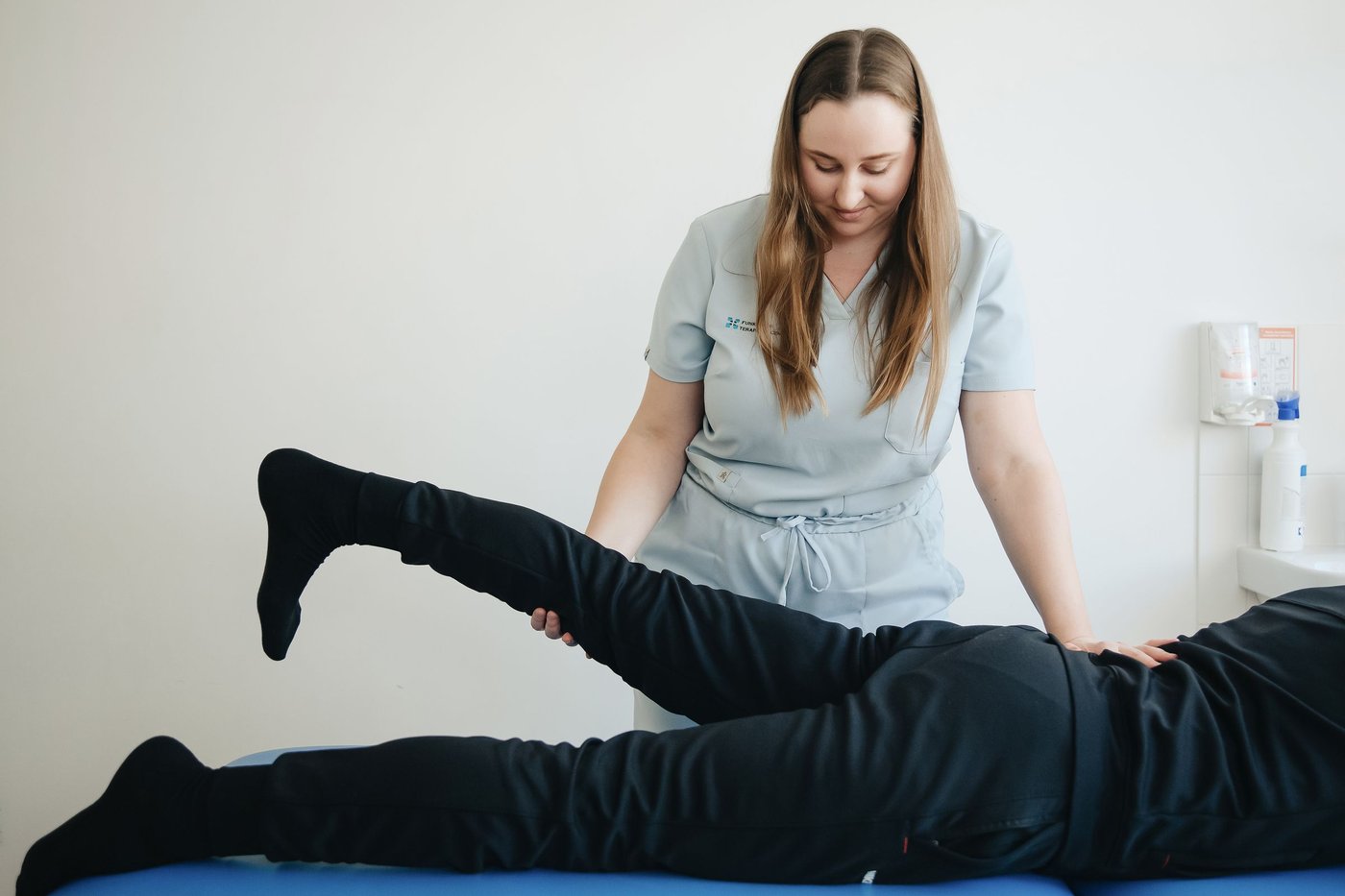
According to the NHS, see a GP or doctor if:
- Hip pain is stopping you doing normal activities or affecting your sleep
- The pain is getting worse or keeps coming back
- It hasn’t improved after treating it at home for 2 weeks
- Your hip is stiff for more than 30 minutes after waking up
Ask for an urgent appointment if you have severe hip pain that started suddenly without a fall or injury, your hip is swollen and feels hot, the skin around it has changed colour, or you have hip pain with a high temperature and feel unwell. Pain that spreads from your buttock down the back of your leg can come from an irritated nerve rather than the hip itself; see our guide to sciatica stretches and get it assessed before stretching through it.
Call emergency services (911 in Canada and the US, 999 in the UK) if you have severe hip pain after a fall or injury, you can’t walk or put weight on your leg, or you have tingling or loss of feeling in your hip or leg after an injury.
Hip Stretches at Your Desk FAQ
What are the best hip stretches to do at a desk?
Good options are seated hip marching, a seated figure-4, a seated knee to opposite shoulder stretch, a seated inner thigh stretch, a standing hip flexor stretch with a hand on the desk, and a standing outer hip stretch. Together they cover the front, back, inner, and outer hip, which all stay in one position when you sit.
How long should I hold a hip stretch at my desk?
The Mayo Clinic suggests holding a stretch for about 30 seconds and repeating it 2 to 4 times per side. An NHS physiotherapy leaflet suggests 20 to 30 seconds for the standing hip flexor stretch. Hip marching is done as slow repetitions, about 5 per leg, rather than a hold.
How often should I stretch my hips at work?
Aim for the full routine once or twice a workday, plus a quick stretch or a short walk whenever you’ve been sitting for an hour. Health guidance suggests stretching at least 2 to 3 days a week; in a small trial, regular hip flexor stretching improved hip range of motion over 3 to 6 weeks.
Does sitting all day make your hip flexors tight?
Sitting keeps your hips bent and your hip flexors in a shortened position for hours, and many people feel tight or stiff at the front of the hip when they stand up. Regular stretching and moving through the day are the simplest ways to keep that range.
Can I stretch my hip flexors without getting on the floor?
Yes. The standing hip flexor stretch works with one hand on your desk: step one leg back, tuck your tailbone, and push the back hip gently forward until you feel a stretch at the front of the hip. Hold 20 to 30 seconds per side without arching your back.
When is hip pain a reason to see a doctor instead of stretching?
See a doctor if hip pain hasn’t improved after 2 weeks, stops you sleeping or doing normal activities, or comes with a hot, swollen joint or a fever. Get emergency help for severe pain after a fall or if you can’t put weight on your leg.
Sources
Related reading
- How to Fix Rounded Shoulders: The Complete Evidence-Based Guide
- Hip Mobility Exercises: The 12 Best Movements for Unlocking Tight Hips
- Lower Back Pain Stretches: The 10 That Actually Work (And the Science Behind Them)
- Hip Internal Rotation Stretches: The Most Restricted Hip Movement and How to Restore It
- Lower Back Stretches You Can Do at Your Desk
- Complete Hip Mobility Guide
- Shoulder & Thoracic Spine Guide
Put it into practice
Ready to apply what you've learned?
MotionLab builds personalised mobility sessions around your specific restrictions — so every minute you invest targets what you actually need.
Start a session on MotionLab →