 MotionLab
Lower Back Stretches You Can Do at Your Desk
MotionLab Editorial · 12 min read · Mobility
Six lower back stretches you can do at your desk, with hold times from Mayo Clinic and NHS guidance, how often to do them, and when back pain needs a doctor. Hours in a chair keep your lower back, hips, and hamstrings in one position, which can leave the lower back stiff and achy. Six moves cover it: seated pelvic tilt, seated knee hug, seated lower back twist, seated figure-4, seated hamstring stretch, and a standing back extension.

Key Takeaways
- ✓Hours in a chair keep your lower back, hips, and hamstrings in one position, which can leave the lower back stiff and achy. Short stretch breaks you can do without leaving your desk are the easiest counter
- ✓Six moves cover it: seated pelvic tilt, seated knee hug, seated lower back twist, seated figure-4, seated hamstring stretch, and a standing back extension. The whole routine takes about 5 minutes
- ✓Hold times come from health guidance: 10–15 slow pelvic tilts (NHS), about 30 seconds per leg for the knee hug and hamstring stretch, and 10-second twists repeated 3 to 5 times each side (Mayo Clinic)
- ✓Research on office workers links regular stretching and exercise to less lower back pain. Stop any move that hurts, and see a doctor for pain that doesn’t improve after a few weeks or that comes with numbness, tingling, or pain spreading down a leg
Lower Back Stretches at Your Desk
The best lower back stretches at your desk are gentle moves you can do from a stable chair: rocking your pelvis back and forth, hugging one knee toward your chest, twisting with your elbow braced on your knee, crossing an ankle over your knee and hinging forward, stretching a hamstring with your heel on the floor, and standing up to lean back. Move slowly, stop at gentle tension, and repeat the routine a few times a workday.
The NIH Division of Occupational Health and Safety notes that as little as 10 minutes of exercise a day can help prevent low back pain, and that the exercises shouldn’t cause pain. This guide gives you six lower back stretches you can do at work without lying on the floor, how long to hold each one, how often to do them, what the research says, and when lower back pain needs more than a stretch. If you have floor space and time, our lower back stretches for pain relief cover the classic floor routine.
Why Does Your Lower Back Get Stiff When You Sit All Day?
Your lower back (the lumbar spine and the muscles around it) works closely with your hips and pelvis. When you sit for hours, all three stay locked in roughly the same position, and the lower back is often the first place you feel it.
A few things tend to add up:
- Slumping. As you tire, your pelvis tends to roll back and your lower back rounds into the chair, especially if the seat is too deep or the backrest doesn’t support you. See how to stop slouching at your desk.
- Hips stuck in one position. Sitting keeps your hips bent for long stretches, so the hip flexors, glutes, and hamstrings, which all attach around the pelvis, can feel tight when you finally stand up. These hip flexor stretches and hamstring stretches go deeper on each.
- Perching or leaning. Sitting on the front edge of the seat, or leaning toward a screen, takes the backrest out of the job and leaves your lower back muscles holding you up.
- Not moving. Even a good posture gets uncomfortable if you hold it for hours. Changing position matters as much as the position itself.

Stretching won’t fix a chair that slumps you, but it’s the quickest way to move a stiff lower back in the middle of a workday.
6 Lower Back Stretches You Can Do at Your Desk
Use a solid chair without wheels and without arms, as the NHS recommends for seated exercises, or lock your casters. Sit toward the front of the seat with your feet flat on the floor and your knees at about a right angle. Breathe freely, don’t bounce, and move only to a gentle stretch. If it hurts, you’ve gone too far.
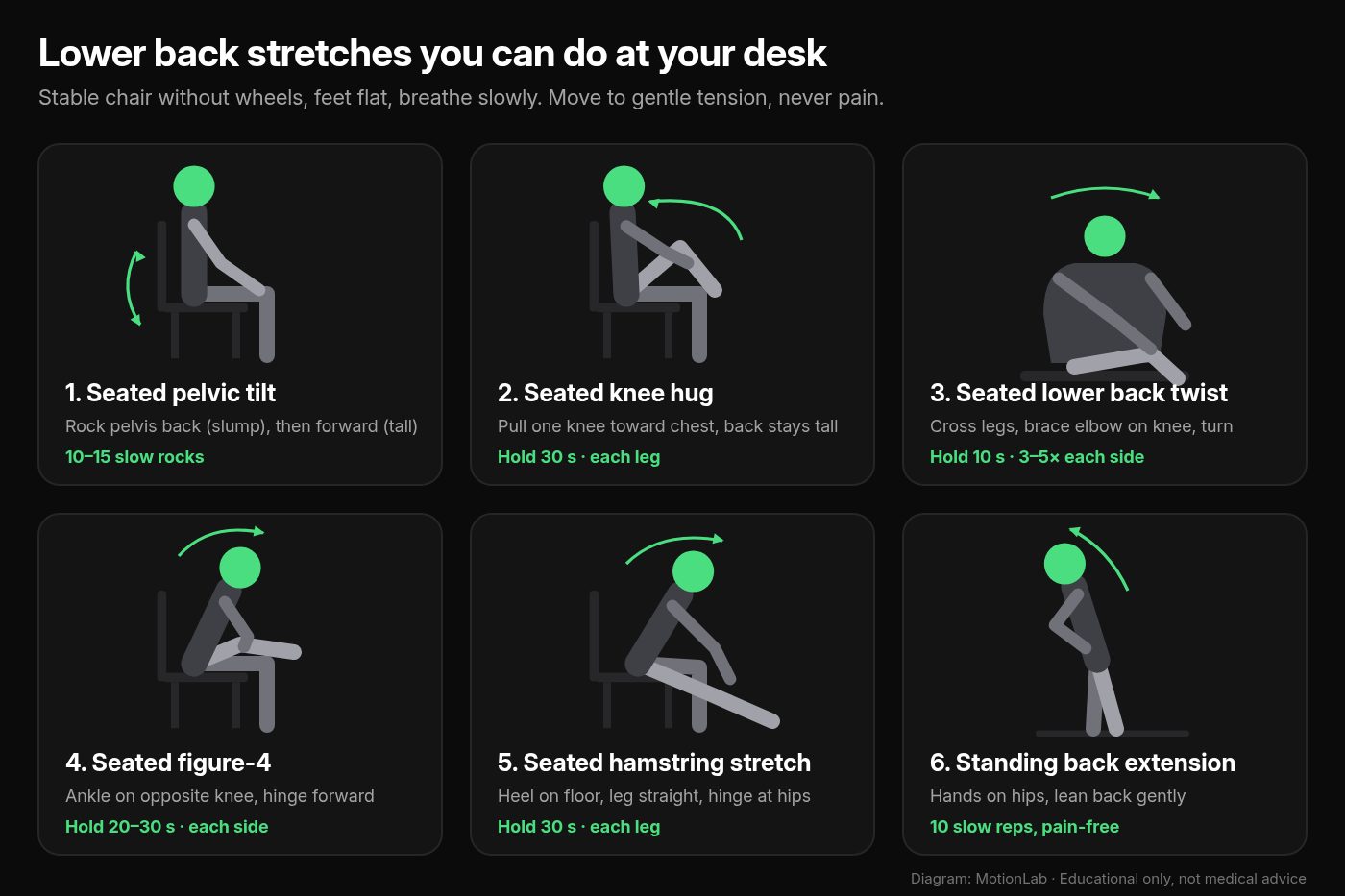
1. Seated pelvic tilt
Sit tall with your hands on your thighs. Slowly let your lower back round as you tip your pelvis backward into a slump, then sit up tall as you tip your pelvis slightly forward so your lower back gently arches. An NHS back rehabilitation leaflet describes this as a pelvic tilt you can do sitting in a chair and suggests 10 to 15 slow rocks. It’s a good warm-up for the rest of the routine.
2. Seated knee hug
Sit tall, grab behind one thigh with both hands, and pull your knee toward your chest while keeping your back straight. You should feel it in your lower back and the top of your buttock. The Mayo Clinic suggests holding for 30 seconds, then switching legs.
3. Seated lower back twist
Sit on a chair without arms, or a stool, and cross your right leg over your left. Brace your left elbow against the outside of your right knee and gently twist toward the right. The Mayo Clinic suggests holding 10 seconds, repeating 3 to 5 times on each side, up to twice a day. Turn slowly and keep it in a comfortable range.
4. Seated figure-4
Rest your right ankle on your left thigh, just above the knee. Place your forearm on the raised knee and, with your back straight, lean forward from your hips until you feel a stretch in your outer hip and buttock. The Mayo Clinic includes this seated hip stretch in its stretch routines; we suggest holding it 20 to 30 seconds, then switching sides. Tight glutes and hips often show up as lower back discomfort, so this one is worth keeping.
5. Seated hamstring stretch
Sit near the edge of your chair, straighten one leg in front of you with your heel on the floor, and hinge forward at your hips with your back straight until you feel a stretch along the back of your thigh. The Mayo Clinic suggests holding 30 seconds, then switching legs. Lead with your chest rather than rounding your lower back.
6. Standing back extension
Stand up, place your hands on your hips or the small of your back, and gently lean backward within a range that doesn’t hurt, then return to upright. An NHS lower back exercise leaflet suggests 10 slow repetitions without holding at the end. It reverses the forward-bent position you’ve been sitting in all morning.
Want to add one more?
The NHS sitting exercises include hip marching: sit upright, hold the sides of the chair, and lift one leg, knee bent, as high as is comfortable, then lower it and switch, 5 lifts per leg. It gets your hips moving between stretches. For the rest of the body, see neck stretches you can do at your desk, shoulder stretches you can do at your desk, and upper back stretches you can do at your desk.
How Often Should You Do Lower Back Stretches at Work?
There’s no single official dose, but health guidance and research on office workers give a useful range:
- A little every day adds up. The NIH says that as little as 10 minutes a day of exercise can help prevent low back pain, and that walking and other aerobic exercise help too.
- Stretching at work helped office workers. A 2018 randomized trial of 142 office workers with neck, shoulder, and lower back pain found that a stretching program reduced lower back pain scores compared with a control group, and the exercise group was the only one that kept improving between months 4 and 6.
- Exercise lowers the risk of a new episode. A 2018 meta-analysis of randomized trials found that exercise on its own reduced the risk of low back pain by about a third, and suggested that strengthening combined with stretching or aerobic exercise 2 to 3 times a week is a reasonable way to help prevent it. Those programs were broader than desk stretches, so treat them as a reason to keep moving in general, not proof that one routine is enough.
A practical plan: do the six stretches once mid-morning and once mid-afternoon, and pick one or two moves, like the pelvic tilt or the standing back extension, whenever you’ve been sitting for an hour.
Stretches pair well with getting up, too. A short walk loosens your lower back in a way no seated move can; here’s how often to take a walking break from sitting.
If you’d rather follow a routine than remember one, MotionLab builds guided mobility sessions of 7, 15, or 25 minutes around your stiff spots, like the lower back and hips, using AI powered by Gemini. MotionLab is live on the web and Android. Start at /signup when you’re ready.
Desk Setup Changes That Take Pressure Off Your Lower Back
Stretching treats the stiffness. Your setup decides how fast it comes back.
- Sit all the way back. Let the backrest and lumbar support hold the natural curve of your lower back instead of perching forward. How to adjust your office chair walks through seat height, depth, and lumbar support.
- Feet flat, knees about level with your hips. If your feet don’t reach the floor comfortably, use a footrest so your pelvis doesn’t roll back.
- Bring the screen and keyboard to you. Leaning toward a screen or reaching for a mouse pulls you off the backrest. The top of the monitor should sit at or slightly below eye level, about an arm’s length away.
- Alternate sitting and standing. A standing desk can help if you switch positions rather than standing all day; see how long to stand at a standing desk.
- Get up at least once an hour. Standing, walking to refill your water, or doing the standing back extension all count.
For the full picture, see how to sit at a desk without back pain. For a longer floor routine aimed at pain, try these lower back pain stretches.
Common Mistakes With Lower Back Stretches at Your Desk
- Forcing the range. A stretch should feel like gentle tension. The NIH notes that these exercises shouldn’t cause pain, so ease off or skip any move that does.
- Bouncing. Hold steady or move slowly. Bouncing into a stretch makes it harder for the muscles to relax.
- Rounding instead of hinging. In the hamstring stretch and the figure-4, lean forward from your hips with your chest up, rather than curling your lower back toward your knees.
- Holding your breath. Slow breathing helps the muscles let go, especially in the twist and the knee hug.
- Using a rolling or swivel chair. Twisting and leaning on wheels is how chairs slide out from under people. Use a stable chair or lock the casters.
- Stretching once and calling it done. The benefits in the research came from regular routines over weeks, not a single session.
When Should You See a Doctor About Lower Back Pain?
This article is general information, not medical advice. Most lower back pain improves on its own within a few weeks, and the NHS advises staying as active as possible rather than resting in bed. Stop any exercise that makes your pain worse.
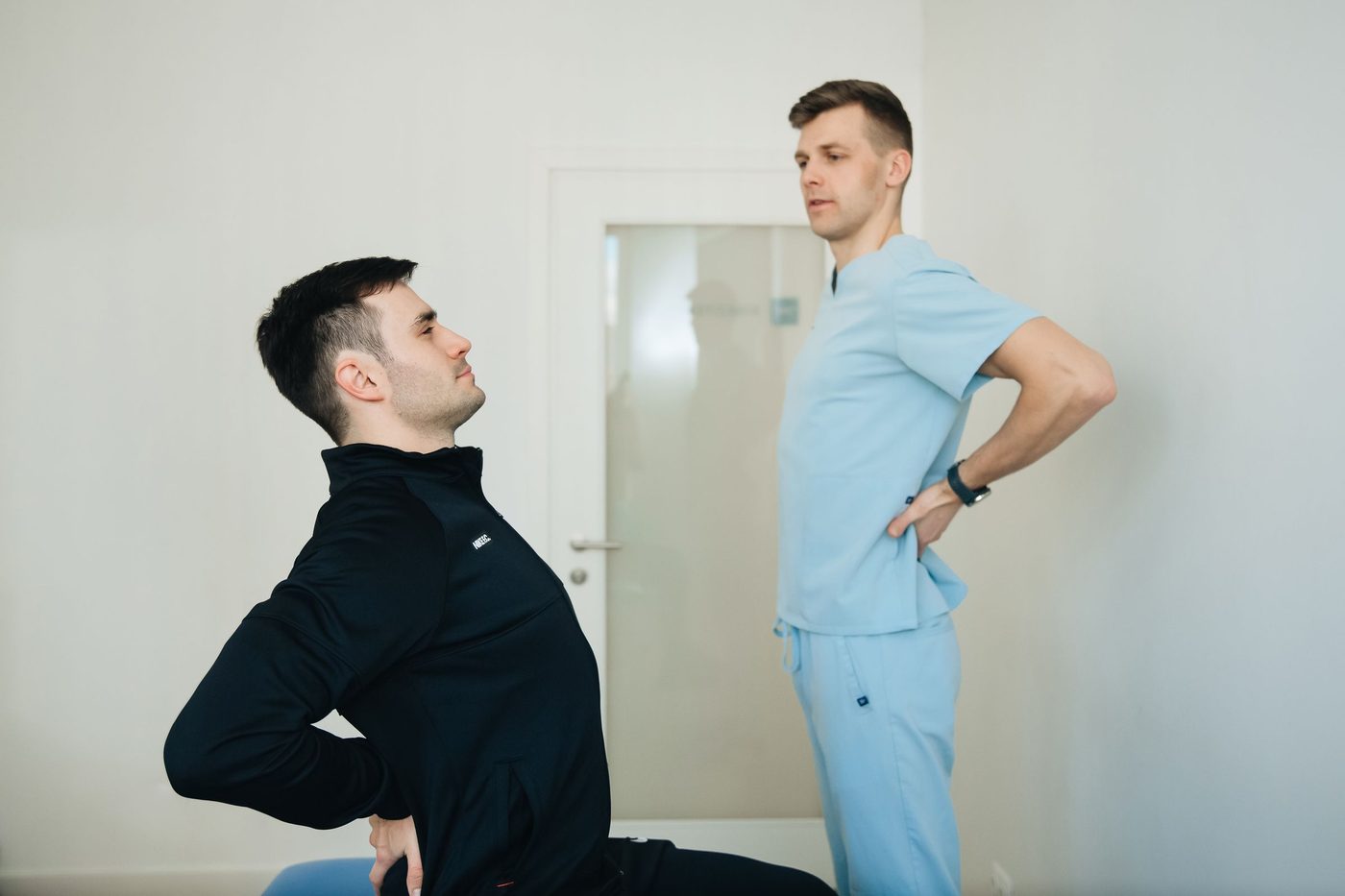
According to the NHS, see a GP or doctor if:
- Your pain hasn’t improved after treating it at home for a few weeks, or it stops you doing your normal activities
- It’s very bad or getting worse, it’s worse at night, or rest doesn’t help
- It gets worse when you cough or sneeze
- You’ve lost weight without trying, or you notice a lump or a change in the shape of your back
Also get checked by a doctor or physiotherapist if pain, numbness, or tingling spreads from your lower back down into your buttock or leg. That pattern can point to an irritated nerve, as with sciatica, and is worth having assessed before you keep stretching through it.
Get urgent medical help if you have back pain with a high temperature and feel unwell, or severe pain that came on suddenly or is getting worse quickly. Call emergency services (911 in Canada and the US, 999 in the UK) if you have numbness, tingling, or weakness in both legs, loss of feeling around your genitals or bottom, changes in bladder or bowel control, chest pain, or back pain after a serious accident or fall.
Lower Back Stretches at Your Desk FAQ
What are the best lower back stretches to do at a desk?
Good options are a seated pelvic tilt, a seated knee hug, a seated lower back twist with your elbow braced on your knee, a seated figure-4 hip stretch, a seated hamstring stretch, and a standing back extension. Together they move the lower back, hips, and hamstrings, which all stiffen up when you sit.
How long should I hold a lower back stretch at my desk?
It depends on the move. The Mayo Clinic suggests about 30 seconds per leg for the seated knee hug and hamstring stretch, and 10-second holds repeated 3 to 5 times each side for the seated twist. Pelvic tilts and standing back extensions are done as slow repetitions, about 10 to 15, rather than holds.
How often should I stretch my lower back at work?
Aim for the full routine at least twice a workday, plus a quick move whenever you’ve been sitting for an hour. The NIH notes that as little as 10 minutes of exercise a day can help prevent low back pain, and regular movement breaks matter as much as the stretches themselves.
Can stretching at my desk help lower back pain from sitting?
It can help. In a randomized trial of office workers with neck, shoulder, and lower back pain, a stretching program reduced lower back pain scores compared with a control group. It works best combined with a better chair setup and regular breaks. Pain that doesn’t improve after a few weeks should be checked by a doctor.
Is it safe to twist my lower back at my desk?
Gentle twists within a comfortable range are fine for most people, and the Mayo Clinic includes a seated lower back rotational stretch in its back exercises. Use a chair without wheels, turn slowly, and don’t force your spine to crack. Stop if a twist causes pain, or if pain spreads down your leg.
Should I stretch if my lower back pain goes down my leg?
Be cautious. Pain, numbness, or tingling that spreads into your buttock or leg can be a sign of an irritated nerve, and it’s worth having a doctor or physiotherapist assess it first. If you have numbness or weakness in both legs or changes in bladder or bowel control, get emergency help.
Sources
Related reading
- How to Test Your Mobility at Home: The 6-Joint Assessment That Reveals Your Weakest Areas
- Lower Back Pain Stretches: The 10 That Actually Work (And the Science Behind Them)
- Morning Stretches: A 10-Minute Routine for Mobility, Energy, and Pain Prevention
- How to Fix Rounded Shoulders: The Complete Evidence-Based Guide
- Neck Stretches You Can Do at Your Desk
- Shoulder & Thoracic Spine Guide
- Lower Back Mobility & Pain Relief Guide
Put it into practice
Ready to apply what you've learned?
MotionLab builds personalised mobility sessions around your specific restrictions — so every minute you invest targets what you actually need.
Start a session on MotionLab →