 MotionLab
Chest Stretches You Can Do at Your Desk
MotionLab Editorial · 11 min read · Mobility
Five chest stretches you can do at your desk to ease tight, rounded shoulders, with NHS hold times, how often to do them, and when chest pain needs a doctor. Hours of reaching forward to a keyboard, mouse, and screen keep your shoulders rounded and your chest muscles in a shortened position, so the front of your chest and shoulders can feel tight by the end of the day

Key Takeaways
- ✓Hours of reaching forward to a keyboard, mouse, and screen keep your shoulders rounded and your chest muscles in a shortened position, so the front of your chest and shoulders can feel tight by the end of the day
- ✓Five moves cover it: shoulder rolls, a seated chest opener, the hands-behind-head stretch, shoulder blade squeezes, and a one-arm doorway stretch. The whole routine takes about 4 minutes and needs no equipment
- ✓Hold times come from NHS guidance: 5 to 10 seconds for the seated chest opener, 10 to 20 seconds for the hands-behind-head stretch, 10 seconds for shoulder blade squeezes, and 30 seconds for the doorway stretch
- ✓Stop any move that hurts or brings on tingling or numbness. Chest pain that feels like pressure or squeezing, or spreads to your arm, neck, jaw, or back, is a medical emergency, not a tight muscle
Chest Stretches at Your Desk
The best chest stretches at your desk are simple moves you can do in a few minutes: rolling your shoulders back, opening your arms wide and lifting your chest, lacing your hands behind your head and easing your elbows out, squeezing your shoulder blades together, and stretching one arm at a time against a door frame. Move slowly, stop at gentle tension, and repeat the routine a few times a workday.
The Mayo Clinic suggests stretching until you feel a slight pull, keeping stretches gentle and slow, and stopping if you feel pain. This guide gives you five chest stretches you can do at work, how long to hold each one, how often to do them, what the research says, and when chest or shoulder pain needs more than a stretch. If rounded shoulders are your main concern, our guide on how to fix rounded shoulders goes further.
Why Does Your Chest Feel Tight After Sitting at a Desk?
Almost everything at a desk sits in front of you. Your hands reach forward to the keyboard and mouse, your eyes follow the screen, and as the day goes on your shoulders tend to drift forward and round. In that position the muscles across the front of your chest and shoulders spend hours shortened, while the muscles between your shoulder blades spend hours lengthened.
A few things tend to add up:
- Reaching forward all day. A keyboard or mouse placed too far away pulls your arms and shoulders forward.
- A screen that’s too low or too far. Leaning in to read pulls your head and shoulders forward. See how high your monitor should be.
- Slouching as you tire. Sliding down in your chair rounds your upper back and closes up your chest. Here’s how to stop slouching at your desk.
- Not changing position. Any posture gets uncomfortable if you hold it for hours.

One of the chest muscles, the pectoralis minor, attaches to the front of your shoulder blade. A 2006 study in the Journal of Shoulder and Elbow Surgery notes that a shortened pectoralis minor in healthy people is linked with changes in how the shoulder blade moves. Stretching won’t undo a day at the computer on its own, but it’s a quick way to open the front of your chest without leaving your desk. Tight chests often travel with a stiff neck, so it pairs well with neck stretches you can do at your desk.
5 Chest Stretches You Can Do at Your Desk
Sit tall on a stable chair, away from the backrest, with your feet flat and your shoulders relaxed. Breathe freely, don’t bounce, and move only to a gentle stretch. If a move hurts, or brings on tingling or numbness in your arm or hand, stop.
1. Shoulder rolls
Sitting tall, slowly roll your shoulders forward 3 times, then backward 3 times, making the circles as big as is comfortable. A Newcastle Hospitals NHS occupational health leaflet uses this as a quick desk warm-up for the neck and shoulders.
2. Seated chest opener
Sit upright and away from the back of the chair. Pull your shoulders back and down and stretch your arms out to the sides. Gently push your chest forward and up until you feel a stretch across your chest. The NHS says this stretch is good for posture and suggests holding for 5 to 10 seconds and repeating 5 times.
3. Hands-behind-head stretch
Sitting tall, place your hands behind your head and bring your elbows out to the sides to open up and stretch your chest. Don’t arch your lower back or push your head forward. A King’s College Hospital NHS leaflet for desk workers suggests holding for 10 to 20 seconds, up to five times through the day.
4. Shoulder blade squeezes
Sit or stand with your ears over your shoulders. Squeeze your shoulder blades back together to open up the chest and the front of your shoulders, then let your shoulders relax. The King’s College Hospital leaflet suggests holding for 10 seconds and repeating five times through the day. This one strengthens the upper back as much as it stretches the chest.
5. One-arm doorway stretch
Stand next to a door frame or wall. Straighten one arm and place your hand against the frame at about chest height. Gently turn your upper body away from that arm until you feel a stretch in the chest. A North Cheshire and Mersey NHS physiotherapy sheet suggests holding for 30 seconds. Switch sides. In a 2006 study of 50 people, a one-arm self-stretch done standing lengthened the pectoralis minor more than two stretches done with a therapist’s help.
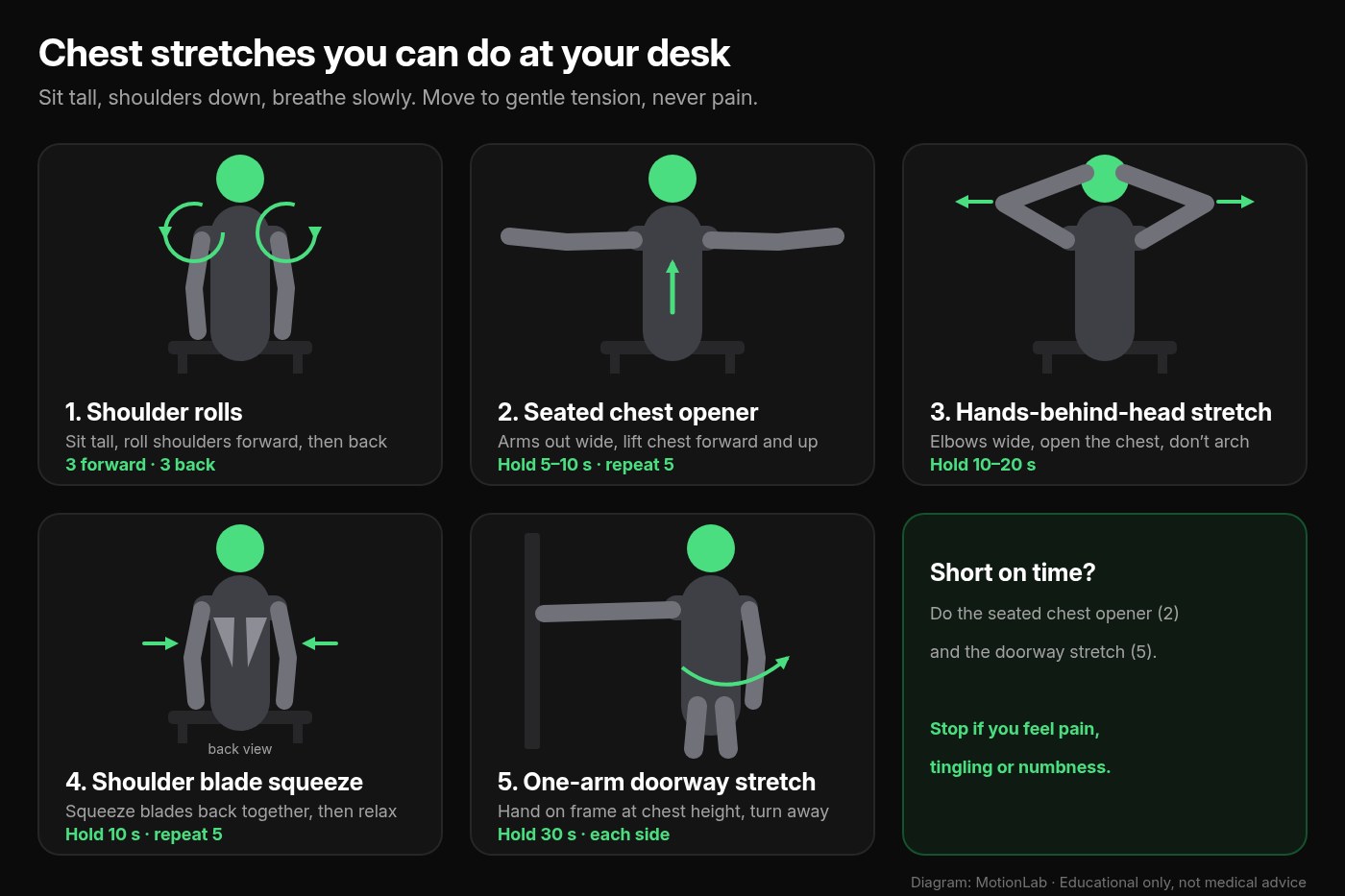
Short on time?
Do the seated chest opener at your desk and the doorway stretch next time you get up. Together they take about two minutes. For the rest of your upper body, see shoulder stretches you can do at your desk and upper back stretches you can do at your desk.
How Often Should You Stretch Your Chest at Work?
There’s no single official dose for desk stretching, but health guidance and research give a useful range:
- Little and often. The King’s College Hospital NHS leaflet suggests micro breaks every 20 minutes, taking 20 seconds to reset your posture, change position, stretch, or move. The Newcastle Hospitals leaflet says it’s important to change position and move your joints every 30 minutes.
- Breaks matter as much as the stretches. In a 2007 NIOSH field study of 51 data-entry workers, adding four extra 5-minute breaks to the workday lowered discomfort and eyestrain, and work output held up despite the lost time. Workers asked to stretch during breaks only did so in 25 to 39% of them, and the study couldn’t show an extra effect from stretching. The lesson: the routine only helps if it’s short enough that you actually do it.
- Workplace stretching helped office workers. A 2018 randomized trial of 142 office workers with neck, shoulder, and lower back pain found that a workplace stretching program reduced pain scores compared with a control group.
- Stretching is one part of the picture. Chest stretches can make tight shoulders feel better, but they won’t hold your posture for you. Strengthening the upper back with moves like shoulder blade squeezes, and setting up your desk well, matter too.
A practical plan: do the five moves once mid-morning and once mid-afternoon, and do a seated chest opener whenever you notice your shoulders creeping forward.
Getting up helps, too. A short walk lets your arms swing and your chest open in a way sitting never does; here’s how often to take a walking break from sitting.
If you’d rather follow a routine than remember one, MotionLab builds guided mobility sessions of 7, 15, or 25 minutes around your stiff spots, like the chest, shoulders, and upper back, using AI powered by Gemini. MotionLab is live on the web and Android. Start at /signup when you’re ready.
Desk Habits That Keep Your Shoulders From Rounding
Stretching opens the chest. Your setup and habits decide how fast your shoulders round again.
- Bring your keyboard and mouse closer. If you have to reach, your shoulders follow your hands forward. Keep them close enough that your elbows stay near your sides.
- Raise your screen. A screen at eye level stops you leaning in and down. See how high your monitor should be and how far away it should sit.
- Set your chair first. Sit back in the chair with your lower back supported. How to adjust your office chair walks through height, depth, and armrests.
- Don’t work on a laptop all day. A laptop screen sits too low for good posture. An external keyboard and a raised screen help; see our laptop desk setup guide.
- Reset your posture through the day. The NHS advises standing up straight with your shoulders down and gently back, and not slouching when sitting.
For the full picture, see how to sit at a desk without back pain.
Common Mistakes With Chest Stretches at Your Desk
- Arching your lower back. It’s easy to push your ribs and belly forward instead of opening your chest. Keep your lower back neutral; the King’s College Hospital leaflet says not to arch it in the hands-behind-head stretch.
- Shrugging. Keep your shoulders down and away from your ears, especially with your arms out wide or behind your head.
- Pulling your head forward. Keep your ears over your shoulders. Don’t push your head into your hands.
- Pushing too far. A stretch should feel like a slight pull. The Mayo Clinic says that if you feel pain, you’ve stretched too far.
- Stretching into tingling. If a stretch brings on pins and needles or numbness in your arm or hand, ease off. That isn’t muscle tightness.
- Holding your breath. Breathe slowly through each stretch. A slow breath out often helps the chest relax.
When Should You See a Doctor About Chest or Shoulder Pain?
This article is general information, not medical advice. Tightness across the front of your shoulders from sitting usually eases with movement and breaks. But chest pain is different from a tight muscle, and the NHS advises not trying to diagnose the cause yourself. Stop any stretch that makes your pain worse.
Call 999 (or your local emergency number) straight away if you get sudden pain or discomfort in your chest that doesn’t go away, pain that spreads to your arm, neck, jaw, stomach, or back, or chest pain with sweating, feeling sick, feeling light-headed, or shortness of breath. According to the [NHS](https://www.nhs.uk/symptoms/chest-pain/), you could be having a heart attack.

See a GP or doctor if:
- You have chest pain that comes and goes, or chest pain that goes away quickly but still worries you
- Shoulder pain is getting worse or hasn’t improved after 2 weeks
- It’s very difficult to move your arm or shoulder
The NHS advises getting an urgent appointment or calling 111 if you have sudden or very bad shoulder pain, can’t move your arm, have pins and needles that don’t go away or no feeling in your arm, your shoulder has changed shape or is badly swollen, the pain started after an injury or fall, or you feel feverish or unwell.
A physiotherapist can also check your posture and shoulder movement and give you exercises that suit you.
Chest Stretches at Your Desk FAQ
What are the best chest stretches to do at a desk?
Good options are shoulder rolls, a seated chest opener with your arms out wide, the hands-behind-head stretch, shoulder blade squeezes, and a one-arm doorway stretch. The first four can be done in your chair; the doorway stretch takes a few seconds standing next to a door frame or wall.
How long should I hold a chest stretch?
NHS guidance suggests holding the seated chest opener for 5 to 10 seconds and repeating it 5 times, the hands-behind-head stretch for 10 to 20 seconds, and a doorway or wall chest stretch for 30 seconds. The Mayo Clinic suggests about 30 seconds for stretches in general.
How often should I stretch my chest at work?
Aim for the full routine once or twice a workday, plus a quick seated chest opener whenever you notice your shoulders rounding. NHS occupational health leaflets suggest changing position or moving every 20 to 30 minutes.
Do chest stretches help rounded shoulders?
They can help the front of your chest and shoulders feel less tight, and a shortened pectoralis minor has been linked with changes in how the shoulder blade moves. Stretching alone won’t fix your posture, though. Pair it with upper back exercises like shoulder blade squeezes and a desk setup that stops you reaching forward.
Can I do chest stretches without leaving my chair?
Yes. Shoulder rolls, the seated chest opener, the hands-behind-head stretch, and shoulder blade squeezes can all be done sitting. Sit on a stable chair, away from the backrest, so your arms and shoulder blades can move freely.
When is chest pain a reason to get help instead of stretching?
Call 999 or your local emergency number if you have sudden chest pain or pressure that doesn’t go away, pain spreading to your arm, neck, jaw, or back, or chest pain with sweating, sickness, light-headedness, or shortness of breath. See a GP for chest pain that comes and goes, or shoulder pain that hasn’t improved after 2 weeks.
Sources
Related reading
- The Dead Hang Challenge: The Viral Exercise That's Fixing Posture, Grip, and Back Pain in 2026
- Calf Stretches: The 7 Best for Tight Calves (And Why Most People Are Only Doing Half the Work)
- Desk Stretches: 9 Moves to Undo 8 Hours of Sitting (Most Without Leaving Your Chair)
- How to Fix Anterior Pelvic Tilt: 7 Stretches, the Strength Work That Makes Them Stick, and Why Posture Alone Isn't Enough
- The Desk Worker's Mobility Guide: Undoing 8 Hours of Sitting in 15 Minutes
- Shoulder & Thoracic Spine Guide
Put it into practice
Ready to apply what you've learned?
MotionLab builds personalised mobility sessions around your specific restrictions — so every minute you invest targets what you actually need.
Start a session on MotionLab →